
Beethoven by the Brook
Bach in the Countryside with Beethoven

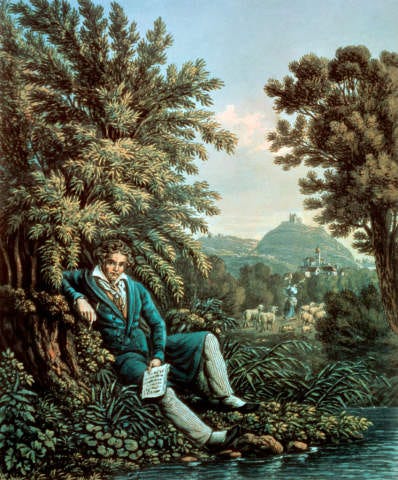
(Anonymous lithograph entitled “Beethoven Composing the ‘Scene by the Brook’”, published in the Zürich Musikgesellschaft Almanac in 1834)
The German word for “brook” is “Bach.” Johann Sebastian Bach had a talented pupil named Krebs, which in English is translated as “crab,” so Bach used to joke that this student was “the best crab in the brook.”
Bach’s literary pictorialism is well documented in, for example, Albert Schweitzer’s two-volume biography, where we learn that Bach — like most Baroque composers — frequently depicts people, angels, earthquakes and bodies of water like the rivers of Babylon and the Jordan.
Bach probably portrayed himself as a body of water — a brook, that is — in the piece that opens the famous two-volume collection “The Well-Tempered Clavier,” a deceptively simple movement entitled Prelude in C Major. On the face of it, this prelude might seem an unlikely vehicle to capture the composer’s Shakespearean range of emotion, character and style. None of Bach’s hallmarks — dense counterpoint, exotic harmonies, singing melodies and danceable rhythms — are present. Indeed, all these distinctive qualities seem to be deliberately erased, resulting in the least Bachian — and technically easiest to play — music he ever wrote.
Certainly Bach had a practical consideration in mind when placing this minimalist etude at the entrance of his massive keyboard cycle. The term “well-tempered” does not refer to a keyboard that’s in a good mood. It refers to a specific tuning system (known as “Werckmeister III”) that tempers the distance between notes in a unique way that makes all 24 major and minor keys available to the performer.
The C-major prelude’s reduction of resources to a series of even, repeated broken chords enables the player to hear how well the temperament method has tuned the instrument. This is surely the reason why Bach has taken pains to include the five “black key” notes (imagine the visual layout of a piano keyboard’s white and black keys) among the seven “white key” notes that constitute the scale of C-major: all twelve possible pitches, black and white, are incorporated into the music so that we can hear how well each sounds in Werckmeister’s tuning scheme.
That explains Bach’s rejection of soaring melody and ravishing chord changes and his embrace of a rhythmically uniform texture presented one note at a time throughout the entire piece. He’s giving each well-tuned pitch a chance to sustain and repeat itself so we can savor its singular intonation without any distracting features.
Bach steps back from the temperament’s display case by removing himself — his typical polyphony, tunefulness, harmonic exploration and rhythmic incisiveness — so that we can focus on the sounds instead of on who wrote them.
How then can I say that Bach possibly portrays himself in the C-major Prelude, when I’ve just inventoried his complete absence?
In some of Bach’s works, such as the late cycle “The Art of the Fugue”, he identifies himself by signing his name with the letters we use to designate the notes of the C-major scale: A, B, C, D, E, F and G. Now, German music notation uses the letter H for what we call B, and what we call B-flat, they call B-natural, so the letters B-A-C-H can be played as a melody.
But Bach has not spelled his name as a theme in the opening prelude of “The Well-Tempered Clavier.” Instead, he has painted a picture of a brook. We hear repeated waves of sound, breaking from below upward in steady succession like ripples coming ashore. We can even see these shapes in Bach’s autograph manuscript:
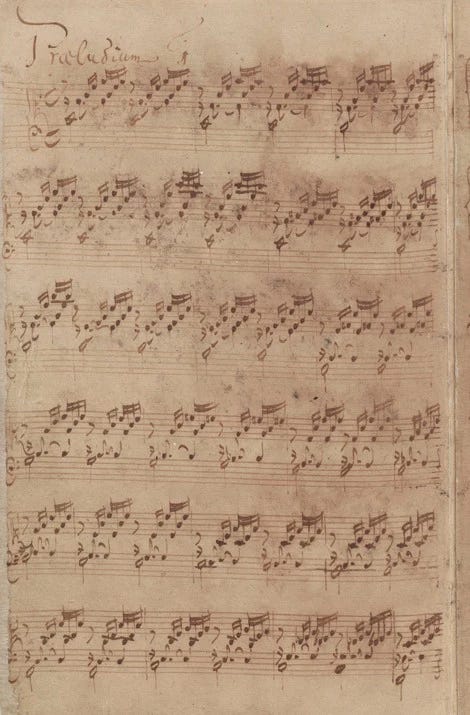
The stream of sound begins in the keyboard’s upper register (middle C is the initial bass note) and meanders the entire span of the instrument, then falls to its final depths, where the music anchors on a long low note, the way a river deepens once it arrives at the sea.
(Lang Lang plays Bach, Prelude in C-major from The Well-Tempered Clavier, Book 1)
In his first sketch of the Sixth (“Pastoral”) Symphony Beethoven wrote a fragment he entitled “Murmeln der Bäche” (“murmuring of the brook“), which begins on middle C, the first note of Bach’s Prelude in C-major. Underneath this line of music he added the words, “The bigger the brook, the deeper the sound” (“Je grösser der Bach, je tiefer der Ton”).
Elsewhere Beethoven spoke of Bach as “not a brook — he should be called the sea” (“nicht Bach — Meer sollte er heissen”).
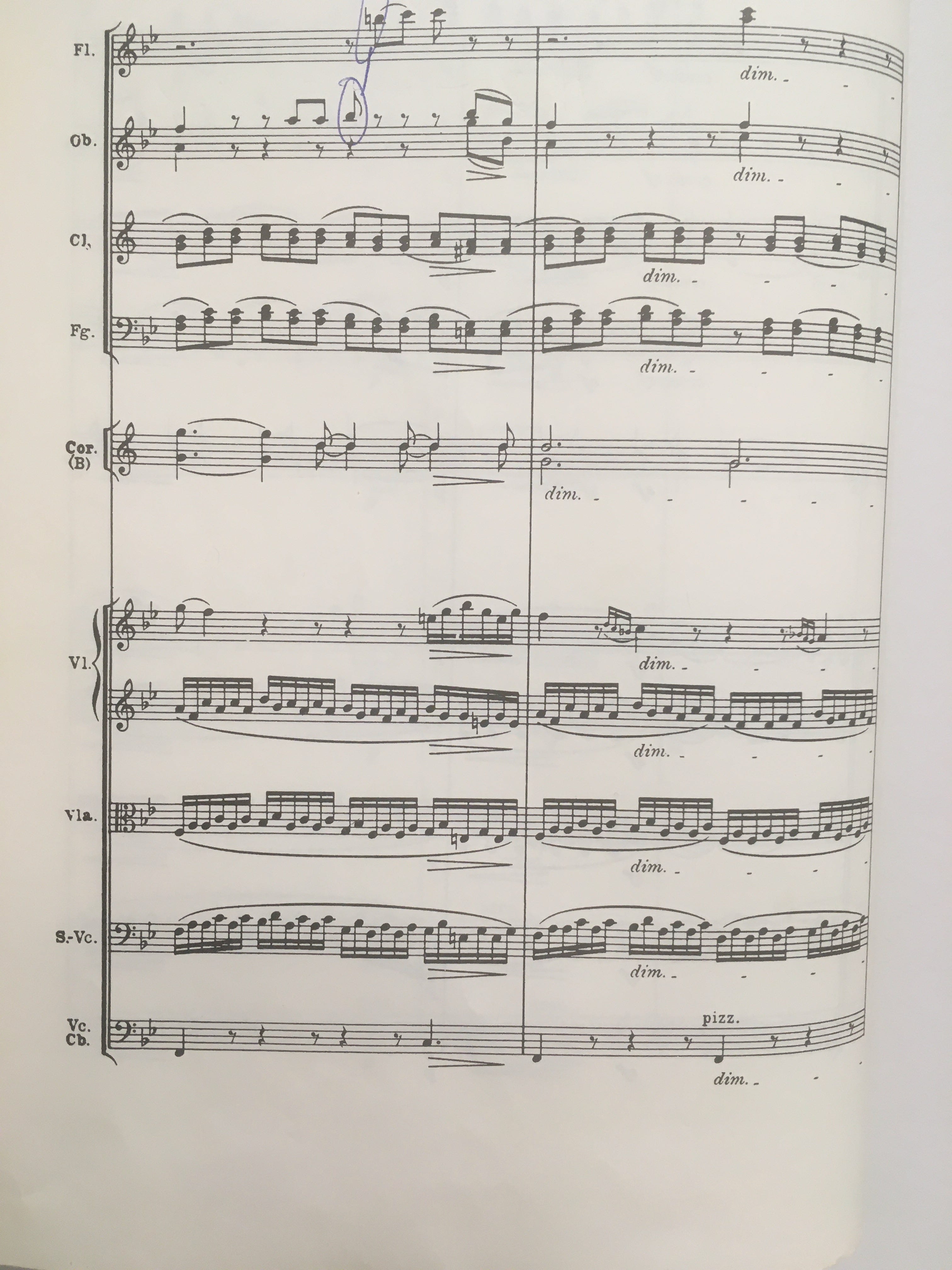
The Sixth Symphony’s second movement is entitled “Szene am Bach” (“Scene at the Brook”) and Beethoven gives a cameo to Bach by creating recurring waves of notes that you can see on the page as undulating scrolls:
In fact Beethoven explicitly tells us that this isn’t just any brook, it’s Bach’s brook since it concludes the sonata-form’s exposition — its presentation of principal themes and rhythmic motives — and inaugurates the development section (where themes and motives are transformed and expanded) with Bach’s signature, spelled out by the high wind parts in very long notes:
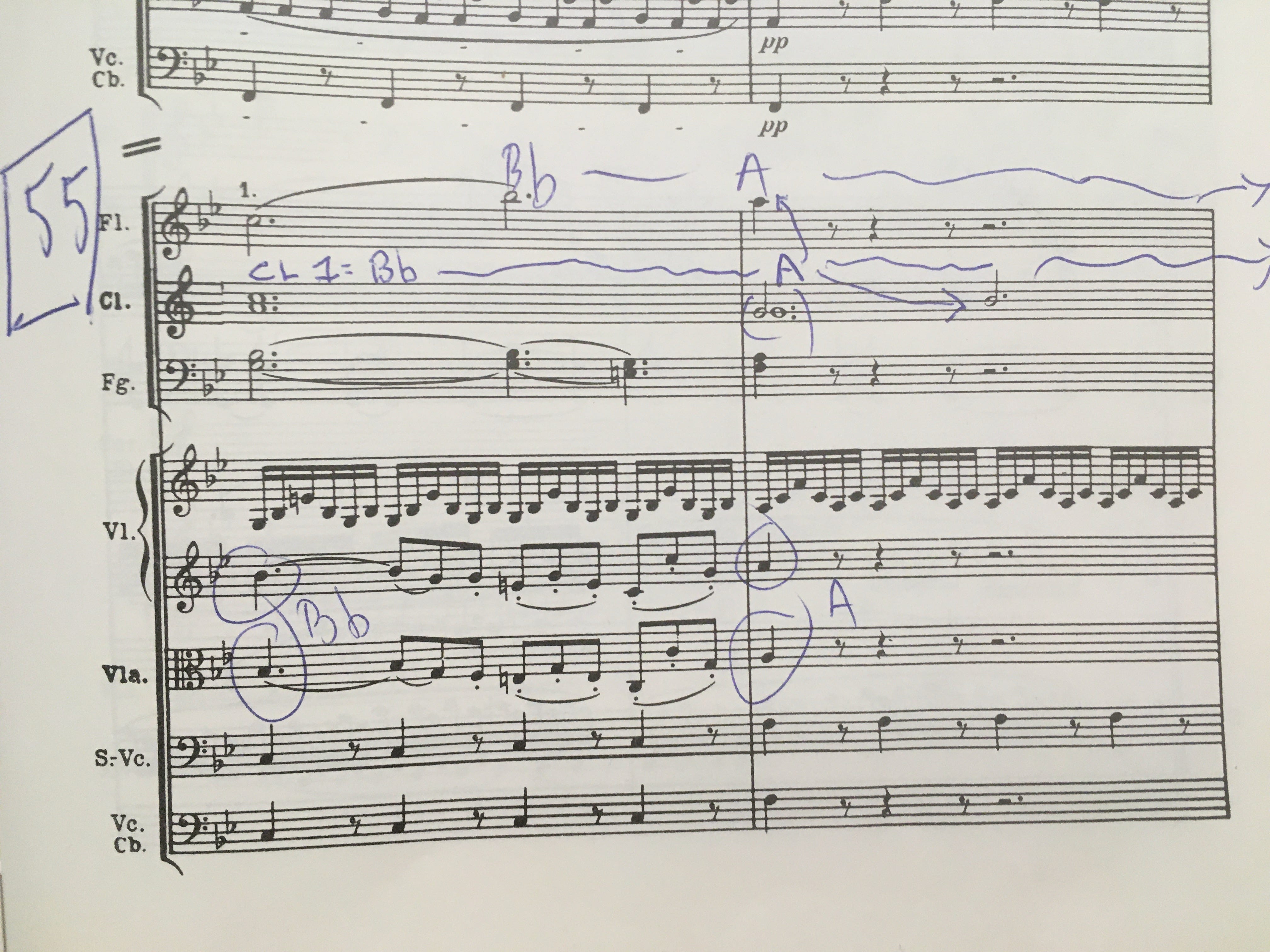
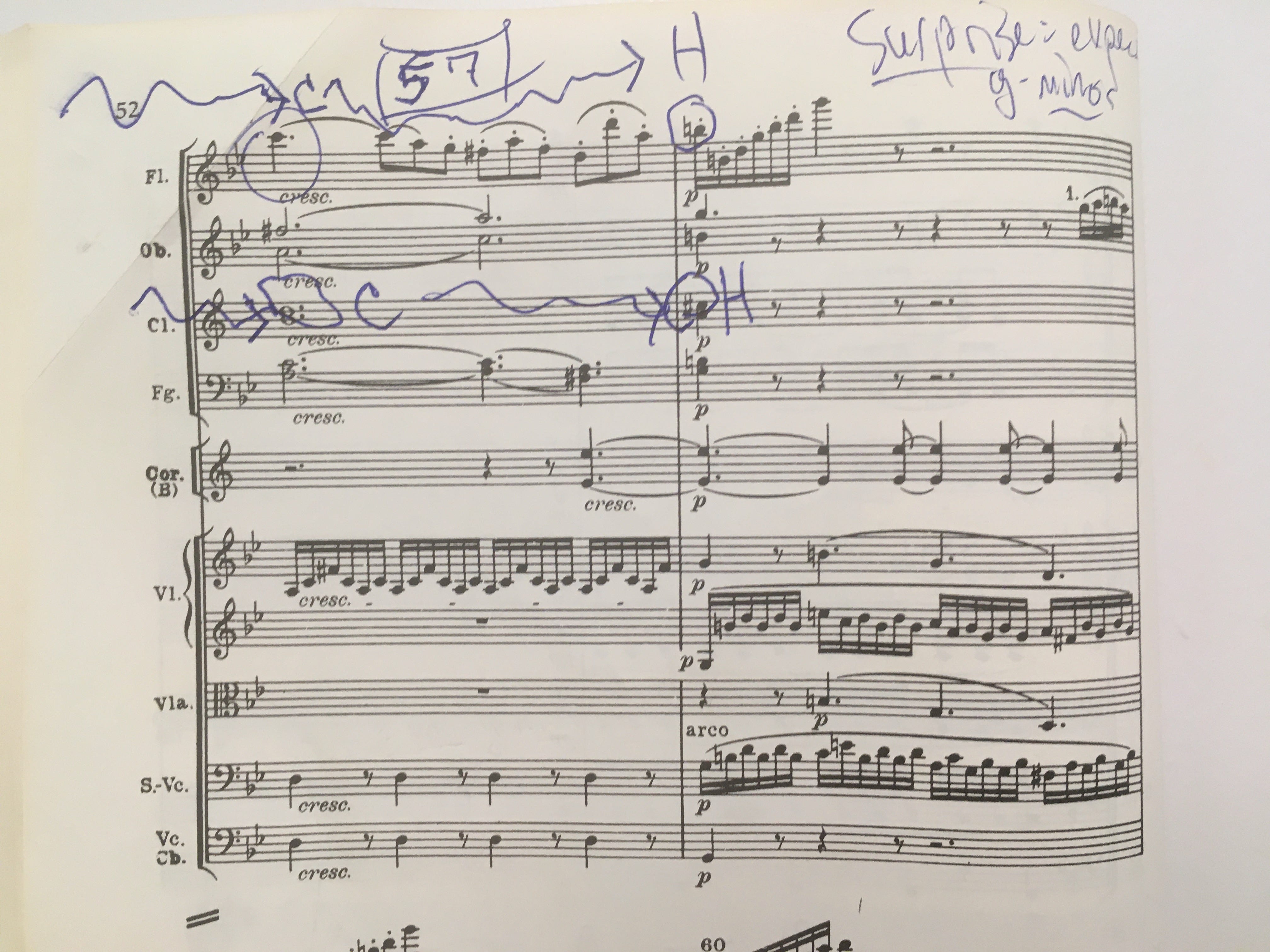
This is a bigger brook with a deeper sound. Where a Bach becomes the sea. It’s the apotheosis of the Well-Tempered Clavier’s inception.
(Haitink/London Symphony Orchestra: Beethoven 6th Symphony, 2nd movement) — The “Szene am Bach” starts at 11:30 and the B-A-C-H signature is found at 15:57 — 16:14
This is an area that I know precious little about, so I am very grateful for your insightful descriptions here, David. Your portrayal of how the compositions evoke water and its movement is beautifully written and does this subject matter justice.
Thank you for sharing something you are clearly passionate about.
Pretty crazy synchronicity, the last live piece of classical stuff I saw was Beethoven's.....6th Symphony. L